
Lagoons made for paddling
Many islands sit in shallow, sheltered lagoons: warm, clear and calm enough for little ones, with turtles and reef fish a short snorkel away for older children.

Choosing the Maldives is the easy bit. Choosing the right island, resort and room is where the difference really is.
Lagoons to paddle in, turtles to snorkel with and resorts built for children. The right island makes all the difference.
Your own villa over the lagoon, sunsets from the deck and dinner on a sandbank. Somewhere that feels like it’s just for you.
Start planningThis isn't only a honeymoon destination. Some islands are excellent for children, with family villas, kids' clubs, calm swimming areas and activities together. Others are deliberately quiet and couple-focused — so picking the right resort matters more than simply choosing the prettiest photograph.
I would look at the ages of the children, room configuration, transfer times, meal plans and how much there is to do beyond the beach. A seaplane transfer can be part of the adventure, but it is not always the easiest option with young children.
There are few places quite like the Maldives for a honeymoon, anniversary or an escape together: private villas, extraordinary lagoons, beautiful sunsets and a sense of being away from everything. But the resorts aren't interchangeable.
Some are peaceful and intimate; others have a livelier atmosphere, more restaurants, diving and water sports. I would help you choose the island and villa around your idea of a memorable trip, not just the brochure photograph.
Typical flight times from London. Time differences change by an hour around when the clocks go forward or back.


Many islands sit in shallow, sheltered lagoons: warm, clear and calm enough for little ones, with turtles and reef fish a short snorkel away for older children.
Pools, restaurants, the kids’ club and the beach are all a short walk away. Once you’ve arrived, the biggest decision of the day is what to do after breakfast.
The best family islands have kids’ clubs, family villas, two-bedroom options and early dinners. Others are deliberately quiet or adults-only, so the island you pick really matters.
 Overwater villas can be brilliant with older children
With younger children, a beach villa is usually the easiest choice: straight onto the sand, more shade and no decking over the water. Overwater villas can be wonderful with older children, but it’s worth checking the steps, the railings and any minimum age the resort sets.
For bigger families, a two-bedroom villa or connecting rooms are often better value than two separate villas, and far more comfortable than squeezing into one.
I’ll check exactly who can sleep where before you book.
These are examples of the kind of resorts I’d compare, not a fixed shortlist. The right one depends on your children’s ages, your dates, the journey and the holiday you have in mind.
Price guide: £ good value · ££ mid-range · £££ top end. Don’t let the top-end ones put you off — tell me your budget and I’ll find the best value for your dates.
 Kuramathi
A long, lively island with a free kids’ club, three pools and around a dozen places to eat. The Two-Bedroom Beach Houses are a real find for families: two storeys, each with its own entrance and living space, sleeping up to six.
Worth knowing: a 20-minute seaplane in daylight, or about 90 minutes by shared speedboat, which runs a few times a day.
Built for families who don’t sit still: the Maldives’ biggest floating water park, horse riding, go-karts, a sports arena with football coaching weeks on selected dates, and a kids’ club for under-12s. Two-bedroom pool villas suit bigger families, and the premium all-inclusive plan covers most of it.
Worth knowing: it’s further out, reached by a 40-minute seaplane or a domestic flight and short speedboat, so your flight times matter.
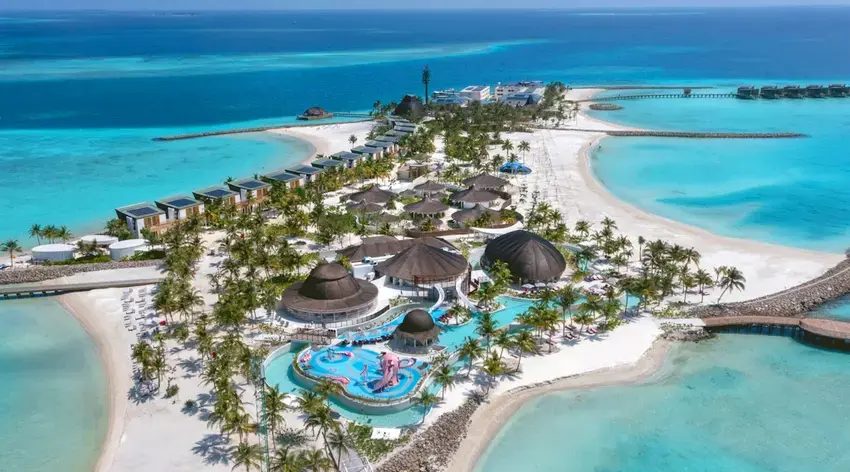 Centara Mirage Lagoon
A newer resort designed around families: a water park with slides, a lazy river and a splash playground, kids’ clubs for 4 to 8s and 9 to 12s, a games room and even a children’s spa. Family rooms have bunk beds, some rooms interconnect, and guests rate it very highly.
Worth knowing: about 40 minutes by speedboat, so there are no seaplane times to plan around.
Facilities, club ages, meal plans and transfer arrangements change. These are examples to discuss, not availability or personal endorsements.

Shallow lagoons for the little ones, and house reefs where older children can snorkel straight from the beach.

Turtles are a regular sight on many house reefs. A guided snorkel with the resort’s marine team is a real highlight.

An evening boat trip to look for dolphins is a favourite family outing at many resorts.
Seaplanes only fly in daylight, so a late landing can mean a night near the airport before you reach the island. With young children, a speedboat resort, or flights that land in good time, makes the first day much easier.
Check cots, baby equipment and the kids’ club’s starting age (often 3 or 4). Babysitting is usually available at a charge.
On a resort island every meal and drink is at resort prices. With children, all-inclusive is often the most predictable choice, but children’s rates and what’s included vary a lot.
February half-term and Easter fall in the drier, busier season. Summer and October half-term are wetter but often better value, and summer is manta season in Baa Atoll.
The children’s ages, when you can travel and roughly what you’d like to spend is enough to start. I’ll come back with two or three islands that genuinely suit you, with the right rooms and the easiest journey for your dates.
Your own villa over the lagoon or on the beach, often with its own pool, and on many islands a team that looks after you by name.
Dinner on a sandbank, snorkelling with turtles and mantas, a sunset cruise or a spa treatment over the water.
No driving and no queues. Once you’re on the island, everything is taken care of and the only plan is each other.
 Honeymoons, anniversaries or just time together
Some islands are tiny and hushed, some are adults-only, and others are livelier, with several restaurants, diving and water sports. For a honeymoon, the transfer, the villa and the meal plan matter as much as the brochure picture.
Overwater villas give you the views and steps into the lagoon; beach villas give you shade and privacy on the sand. Plenty of couples split their stay between the two.
Many resorts add honeymoon extras if you travel within a set time of the wedding, and the rules vary, so do mention it.
These are examples of the kind of resorts I’d compare, not a fixed shortlist. The right one depends on the mood you’re after, your dates, the journey and your budget.
Price guide: £ good value · ££ mid-range · £££ top end. Don’t let the top-end ones put you off — tell me your budget and I’ll find the best value for your dates.
Its INDULGENCE™ all-inclusive plan is the draw: champagne breakfasts, premium drinks, dine-around restaurants and M6m, a restaurant six metres under the lagoon. Beach and overwater villas all face sunrise or sunset.
Worth knowing: 45 minutes by luxury speedboat, running day and night, so no seaplane timings to worry about.
An all-inclusive island in the far south, with 122 villas on the beach and over the water. The one to go for is the Ocean Pool Suite: 185 square metres over the lagoon, with its own pool and big, open sea views. There are even Aqua Villas with a bedroom under the water. Your food and drinks are covered, and some of the best diving in the southern atolls is close by.
Worth knowing: it’s a 55-minute domestic flight from Malé, then about 15 minutes by speedboat, so I’ll match your flights to make the connection easy.
Opened in 2025, with 142 beach and overwater villas, each with its own pool, jacuzzi or both. There’s an overwater champagne bar for sunset and a Thai-inspired spa, and you can use the facilities at its livelier sister resort next door.
Worth knowing: about 45 minutes by speedboat. Families are welcome too, but it’s the quieter, more grown-up of the two.
Facilities, age policies, meal plans and transfer arrangements change. These are examples to discuss, not availability or personal endorsements.

Choose a sunset-facing villa and the evening show is all yours.

Many resorts can arrange a private sandbank picnic or dinner.

Mantas gather in Baa Atoll from roughly June to November, and resort dive teams know the best spots.
The seaplane is half the fun, but it only flies in daylight, so a late landing can mean a night near the airport. A speedboat island avoids that completely.
Sunrise or sunset side, overwater or beach, with or without a pool. A villa that suits you makes more difference than an extra star.
Everything on the island is at resort prices, so compare the total cost, not the room rate. All-inclusive suits some couples; half board and dining out suits others.
December to April is usually drier and busiest. May to November is wetter but often better value, and it’s manta season in Baa Atoll.
Want to see more of the world on the way? Plenty of couples start with a few days in Dubai or Abu Dhabi, or tour Sri Lanka first, about an hour’s flight from Malé.
When you’d like to go, roughly what you’d like to spend and what matters most (the villa, the reef, the food or total peace and quiet) is enough to start. I’ll come back with two or three islands that genuinely suit you.
Each resort has its own island, so it’s private and peaceful.
Warm, shallow and impossibly blue, with a reef full of life.
No driving and no planning. Just choose the right island.

A villa on the sand, steps from the lagoon.
A villa on stilts, with steps down into the sea.
Split the stay: a few nights on the beach, then a few over the water.
Snorkel with them on the house reef.
A sunset cruise to find them.
In season, one of the great wildlife experiences.
If snorkelling is a big part of the holiday, the house reef can matter more than anything else about the resort.
A few days somewhere else first breaks the long journey and makes the islands feel even better.
 Sri LankaTouring, wildlife and tea country first.See the guide
 DubaiCity and desert on the way out.See the guide
 Abu DhabiA quieter stopover.See the guide
About 15 nights. Ten nights touring, then five on an island.
The practical side: when to go, how it fits together and what’s worth deciding early.
The Maldives is warm all year. What changes is the monsoon: drier, calmer weather is more likely in the first part of the year, and showers, wind and choppier seas are more likely from around May. Typical patterns, not guarantees — a wet-season week can be mostly sunny, and a dry-season week can have rain.
| Months | What’s typical | Worth knowing |
|---|---|---|
| December to April | The drier north-east monsoon: more sunshine and calmer seas. | The busiest and most expensive time, especially Christmas, New Year and Easter. |
| May to November | The wetter south-west monsoon: more chance of rain and wind, often in short bursts with sunshine between. | Often better value. Some marine life is seasonal — manta rays gather in Baa Atoll’s Hanifaru Bay around June to November. |
Every resort is its own island, so the last part of the journey depends on where it is. This can matter more than the room you book.
| Transfer | How it works | Worth knowing |
|---|---|---|
| Speedboat | For resorts within reach of Malé — from a few minutes to around an hour. | Can usually run after dark. Sea conditions affect how comfortable it is. |
| Seaplane | A scenic flight to resorts further away. | Daylight only, so your international arrival time matters — a late landing can mean a night near the airport. Baggage limits are lower than on international flights (the main operator allows 20 kg checked and 5 kg hand luggage). |
| Domestic flight and boat | For the most distant atolls. | More waiting between connections. Flights can run later than seaplanes, but the onward boat needs confirming. |
Worth asking for any resort: how long is the transfer from my flight, and what happens if it lands late?
On a resort island, everything you eat and drink comes from the resort — there’s nowhere else to go. So the board basis changes the overall cost more than on most holidays.
Tell me who’s travelling, roughly when, what matters most — the reef, the room, the transfer — and the sort of budget you have in mind. I’ll help narrow the options down.
Start planningOr message me on WhatsApp ↗